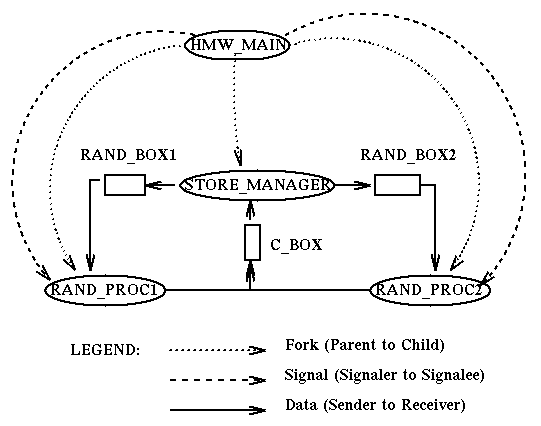
STORE_MANAGER receives messages from RAND_PROC1 and RAND_PROC2 through the pipe C_BOX. It responds to messages from RAND_PROC1 by placing the responses in the pipe RAND_BOX1. It responds to messages from RAND_PROC2 by placing the responses in RAND_BOX2. Each message is time-stamped and logged in the file 'LOG.DAT' by the STORE_MANAGER. Each message is also time-stamped and logged in the file 'CHILDprocid.DAT' by RAND_PROCi.
The STORE_MANAGER keeps in a TABLE at least 12 [TABLE_SIZE] pairs (TABLE_ID, TABLE_ELEM); you choose an initial list of pairs. TABLE_ID and TABLE_ELEM are strings of, respectively, 9 [TABLE_ID_SIZE] and 14 [TABLE_ELEM_SIZE] characters. TABLE_ID represents a social security number [for example "155243352"] and TABLE_ELEM represents the corresponding balance [for example " 4563.75"]. The TABLE carries out two operations TABLE_UPDATE and TABLE_READ.
   function TABLE_UPDATE (WHO : TABLE_ID;
    			    WHAT : TABLE_ELEM) return INTEGER;
    {It updates the value of WHO to be WHAT. It returns 0 iff successful}
    {i.e. if WHO was a TABLE_ID in the table}
    {Note that WHO denotes the pair with first element equal to WHO.}

   function TABLE_READ (WHO : TABLE_ID;
    			  var WHAT  : TABLE_ELEM) return INTEGER;
    {It retrieves the value of WHO and stores it in WHAT.
     It returns 0 iff successful,i.e. if WHO was a TABLE_ID in the table}
Here is an important complication: TABLE_READ and TABLE_UPDATE
are slow operations [assume that they involve IO], taking taking a random
time (say, between 1 and 3 seconds)..
During this time the STORE_MANAGER should be able to work on requests
involving other TABLE_IDs.
To deal with this problem we assume that each operation is
executed as two operations. For TABLE_READ, TABLE_READ_INIT and
TABLE_READ_END, and for TABLE_UPDATE,
TABLE_UPDATE_INIT and TABLE_UPDATE_END.
You decide what should be the parameters to use for these operations.
Here is how the STORE_MANAGER should behave:
   STORE_MANAGER:
       initialization;
       loop
	    wait for the completion of an operation or the arrival
	       of a new request;
            if it is a new request then
	       log the message and start the corresponding operation;
            else if it is a completion then
	       complete the operation, send the response, and log it;
	end loop
        conclusion;
STORE_MANAGER receives messages that consist of, in sequence:
	o An Origin Code [' 1' for RAND_PROC1, ' 2' for RAND_PROC2]
	o A message code ['U' for TABLE_UPDATE, 'G' for TABLE_READ]
	o The  operands required by the corresponding operation [hence for
	  TABLE_UPDATE, the 'U' will be followed by a TABLE_ID value [it
	  is TABLE_ID_SIZE characters]
	  and by a TABLE_ELEM value [it is TABLE_ELEM_SIZE characters],
	  while for TABLE_READ, the 'G' will be followed only by TABLE_ID.]
The STORE_MANAGER responses consist of the character representing the operation requested, followed by the result of the operation ['0' for success, '1' for failure], followed by the values involved in the operation [both TABLE_ID and TABLE_ELEM].
RAND_PROC1 and RAND_PROC2 have the same form [but use different seeds for the random number generator]:
   RAND_PROCi:
       initialization;
       loop
	    generate a random TABLE_READ or TABLE_UPDATE request;
	    [in both operations the TABLE_ID should be selected
	     at random from a list maintained at RAND_PROCi; in the
             TABLE_UPDATE operation TABLE_ELEM should be created using
	     a random number generator]
	    send the request and log it;
	    wait for the corresponding response and log it;
	    wait some random time;
	end loop
        conclusion;
In writing RAND_PROCi you should represent the sending of a message
and the receiving of the corresponding response within calls to the
following functions:
   function TABLE_UPDATE (WHO : TABLE_ID;
    			   WHAT  : TABLE_ELEM) return INTEGER;
    {It updates the value of WHO to be WHAT. It returns 0 iff successful}
    {Note that WHO denotes the pair with first element equal to WHO.}
   function TABLE_READ (WHO : TABLE_ID;
    			  var WHAT  : TABLE_ELEM) return INTEGER;
    {It retrieves the value of WHO and stores it in WHAT.
     It returns 0 iff successful}
I have used the same name and form for the functions used in
STORE_MANAGER to access TABLE, and in processes RAND_PROC1 and
RAND_PROC2 to communicate with STORE_MANAGER. I did it intentionally to
stress that through communication the TABLE is as if it were local to
its users.
HMW_MAIN, after starting the other processes, in a loop prompts the users to ask if they want to see statistical information from RAND_PROC1 and RAND_PROC2.
   HMW_MAIN:
       pid_t pids[3];
       initialization;
       if ((pids[0]=fork())<0) {perror("fork"); exit(1);}
       else if (pids[0]==0) STORE_MANAGER();
       if ((pids[1]=fork())<0) {perror("fork"); exit(1);}
       else if (pids[1]==0) RAND_PROC1();
       if ((pids[2]=fork())<0) {perror("fork"); exit(1);}
       else if (pids[2]==0) RAND_PROC2();
       loop
	   Prompt the User;
	   If the answer is "1" then
		send a signal to RAND_PROC1 [RAND_PROC1
		will write to the screen the number of Read and
		Update messages that it has executed [different
		numbers represents the Reads started and completed,
		and the Updates started and completed]].
	   else if the answer is "2", then
		the same is done with RAND_PROC2
	   else
		send signals to RAND_PROC1, RAND_PROC2 and
		STORE_MANAGER requesting that they terminate;
		wait that they all exit and exit the loop;
	end loop
        conclusion;
RAND_PROC1 and RAND_PROC2 should respond within callbacks to the
signals from HMW_MAIN.
ingargiola@cis.temple.edu